Cocopeat vs Rockwool: Total Cost of Ownership, Disposal and Water Use for Commercial Greenhouses
CBS Agronomy & Export Technical Team
PT Ridha Dua Keluarga • Sidoarjo, East Java, Indonesia

Technical Abstract & Key Parameters
Cocopeat vs rockwool for commercial greenhouses: purchase price is the smallest line. Compare freight, drain recirculation, nutrient loss and disposal cost.
Growers who compare coir and rockwool on price per slab usually compare the wrong number. The slab is bought once per crop. Water, nutrients, freight, labour and disposal are paid every season, and they decide which substrate is cheaper to own. This article lists the cost drivers that differ, states which published data supports each one, and flags where the data is thin.
It is a buyer-side framework, not a quotation. Where a figure is regional or dated, we say so. Local slab prices, waste tariffs and crop programme will move the result, so every grower should rerun the comparison with their own numbers.
Where the Two Substrates Actually Differ
| Cost driver | Rockwool | Coir (compressed) | Source |
|---|---|---|---|
| Nature | Melted dolerite, limestone and coke; inert | Coconut by-product; organic, CEC present | ADAS / HSE |
| Nutrient control | Inert, easy to steer precisely | Needs Ca buffering and a different recipe | ADAS / HSE |
| Freight form | Bulky pre-expanded slabs | Compressed about 5:1, expanded on site | CBS export spec |
| Spent material | Mostly landfill; take-back limited by transport cost | Biodegradable, compostable, reusable | ADAS / HSE; Hort Innovation |
| Re-use | Possible with disinfection and rehydration | Possible, including mixing spent with fresh | Hort Innovation; J. Bio-Environ. Control |
| Water-holding buffer | Higher | Lower in coir dust; varies by origin | MDPI Agronomy |
Two rows matter most: freight form and end of life. Water use looks like a substrate question but is mostly a system question, covered next.
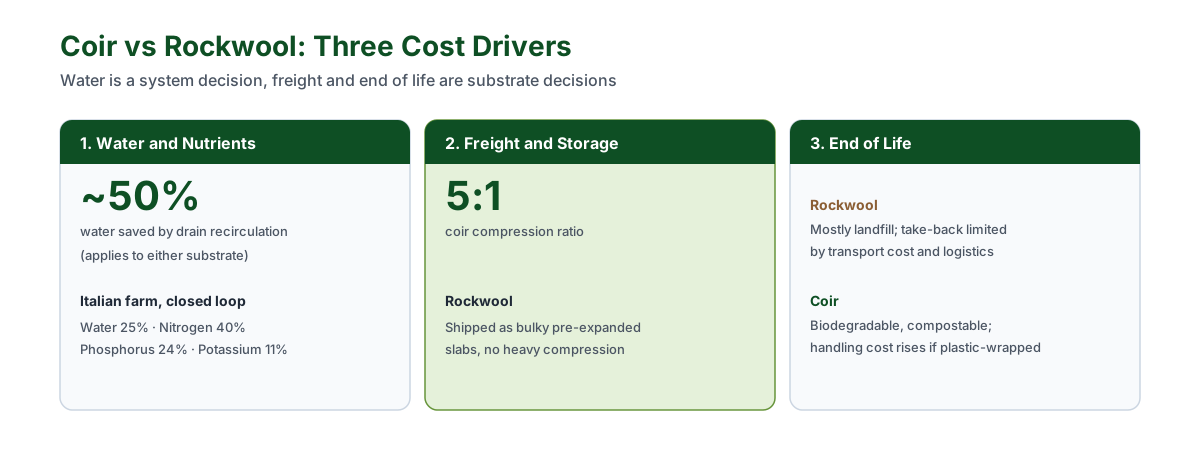
Water and Nutrients: A System Effect, Not a Substrate Effect
Wageningen research on Dutch glasshouses credits growing media that allow drain recirculation with a saving of about 50% of water and removing nitrate and phosphate emissions. The same mechanism works in rockwool and in coir. A grower who recirculates drain water saves water in either substrate.
For nutrients, a commercial tomato farm in Italy recorded savings from a closed irrigation system of 25% water, 40% nitrogen, 24% phosphorus and 11% potassium over one summer season (MDPI Agronomy review). Closed loops carry a risk: sodium and chloride accumulate, so the drain must be monitored.
The practical consequence for coir is specific. Coir holds less buffering water than rockwool and its air space varies by origin, so the irrigation strategy and the particle blend (pith to chips) matter more. A supplier who documents EC and particle composition per lot removes part of that uncertainty. Sourcing from a cocopeat producer in Sidoarjo that publishes lot specifications is one way to do it.
Rockwool is not free of nutrient cost either. An older Ontario best-management guide put fertiliser draining out of rockwool slabs during tomato production at up to USD 6,700 per hectare per year, in 1991 dollars. That figure is dated and applies to open drainage. We cite it only to show that drain management was already a major cost line before recirculation became common.
Freight and Storage
Compressed coir is shipped dry and rigid and expanded at the farm. Our earlier freight article explains the 5:1 compression and 40ft HC loading logic. Rockwool slabs are already expanded, so the same container carries far fewer growing units. Storage space follows the same logic. For a buyer in a far market, freight per unit of finished substrate is where coir usually gains ground, and where the gap grows with distance.
Disposal: The Cost That Arrives Last
ADAS, writing for the UK regulator, notes that spent rockwool modules have little value and generally go to landfill, sometimes baled to save space. Rockwool manufacturers have tried take-back and re-processing, but transport cost and logistics have limited uptake. The Ontario guide makes the same point for North America: inorganic substrates do not decompose, and recycling was not available there.
Coir is biodegradable and compostable. Hort Innovation's Australian review, however, records that handling and recycling spent coir is perceived as costly, especially when wrapped in plastic, and moderate when no plastic is used. So the coir advantage depends on a practical choice: sleeve film that can be separated, and a local outlet such as compost or soil conditioner. Korean research also suggests both spent coir and rockwool can serve as soil conditioners after analysis for heavy metals and pesticide residues, but that remains a study result, not an established disposal channel.
The disposal tariff per tonne differs by country, so we do not give one. Ask the local waste hauler for a written rate for mineral waste, then compare it with the cost of composting or spreading spent coir.
Do Not Rely on Carbon Footprint Alone
Wageningen's life cycle assessment of twelve raw materials and thirty mixes carries a warning. Coir has a considerably lower climate impact than peat, yet coconut cultivation, processing and transport add acidification, nutrient pollution and air pollution. Some coir-heavy mixes had lower climate impact but a higher total environmental burden than a mix with 50% peat. A substrate that needs more water or fertiliser, or has a shorter life, can lose its advantage in practice. Buyers who must report environmental performance should ask for the full impact profile, not a single carbon number.
A Simple TCO Checklist for Buyers
- Slab or bag price delivered to the farm, including freight and import duty, per growing unit rather than per tonne.
- Seasons of use and whether re-use is planned, with the disinfection cost.
- Water and nutrient programme: open or closed drain, and the cost of drain analysis.
- Labour for the first hydration and for crop steering during the transition from inert to organic media.
- End-of-life cost: written waste tariff for mineral material, or the cost of the compost route for coir.
- Risk cost: a failed first crop from poorly buffered coir costs more than any slab discount. Read our EC guide and CEC buffering article before the first order.
Our earlier tomato substrate article shows how the steering side works in practice.
What the Data Does Not Tell You
No source we found gives a single, current, global cost per growing unit for coir against rockwool. Prices depend on origin, grade, freight lane and year. Treat the framework above as the deliverable, and populate it with quotations.
Sourcing High-Spec Cocopeat from Sidoarjo, Indonesia
PT Ridha Dua Keluarga produces washed, low EC compressed coir blocks in East Java, shipped through Tanjung Perak, Surabaya. For buyers building a TCO comparison we can supply:
- Per-lot specification sheets: EC below 0.5 mS/cm and moisture documented.
- Compressed block formats for freight comparison against your current substrate.
- Container-level quotations so freight enters your model as a real number.
Write to [email protected] with your crop, annual volume and destination port.
Related Keywords & Topics
Technical Citations & Referenced Standards
Standard testing methods, government regulations, and industry benchmarks cited in this document.
- [1]UK HSE / ADAS — The Use and Disposal of Growing Media
- [2]Hort Innovation Australia — Coir and its alternatives (RB21002)
- [3]Wageningen University & Research — Sustainable growing media: look beyond carbon footprints
- [4]Agronomy (MDPI) 9(6):298 — Increasing Sustainability of Growing Media Constituents and Stand-Alone Substrates in Soilless Culture Systems
- [5]Ontario BMP — Horticultural Crops: Greenhouse Production
CBS Agronomy Notes
Sourcing 5kg Cocopeat Blocks for Commercial Agriculture?
Receive customized EC/pH lab certificates, container stuffing simulation (palletized or floor loaded), and FOB Tanjung Perak pricing.
Related Technical Notes
View all →
16 November 2026
Strawberry Substrate Guide: Coir Slabs and Grow Bags for Tabletop Soft-Fruit Production
Strawberry on coir: published EC, pH, drainage and irrigation ranges, chip-to-dust ratio effects, reuse across seasons, and how coir compares with peat blends.

9 November 2026
USDA APHIS Biosecurity Compliance: Meeting North American Plant Health Standards for Imported Compressed Coir
How US importers clear compressed coir: APHIS soil rule, ACIR lookup, ISPM 15 pallet marking, phytosanitary documents and the spec controls that avoid port holds.