Cation Exchange Capacity (CEC) in Coir Substrates: Calcium Buffering vs Plain Water Washing
CBS Agronomy & Export Technical Team
PT Ridha Dua Keluarga • Sidoarjo, East Java, Indonesia

Technical Abstract & Key Parameters
Why raw cocopeat releases potassium and sodium during cultivation, and how calcium nitrate buffering compares with plain water washing on CEC, EC, and crop safety.
Raw coconut coir is not a chemically inert substrate.[3] Every kilogram of unwashed cocopeat arrives at the grower's site carrying an electrical charge, a reservoir of soluble salts, and a specific ion profile inherited from the coastal coconut plantations and the retting process that produced it.[1][3]
For commercial greenhouse operators, substrate blenders, and importers, the decisive specification is rarely the physical appearance of the block. It is the cation exchange capacity (CEC) and how that capacity has been conditioned before shipment.[4]
This guide compares the two dominant industrial pre-treatments — plain water washing and calcium nitrate buffering — and sets out the laboratory parameters a professional buyer should demand in a specification sheet.[2]
What CEC Actually Measures
Cation exchange capacity is the medium's capacity to hold and exchange mineral nutrients.[4] When conventional fertilizer dissolves, its salts dissociate into individually charged ions:[4]
Ca(NO3)2 + water → Ca²⁺ + 2 NO3⁻Growing media particles — coir, peat, vermiculite, bark, calcined clay — carry electrical charges on their surfaces.[4] Negative surface charges constitute the cation exchange capacity: positively charged elements (cations) bind to these sites and can later be exchanged for another element taken up by the plant, and the more negatively charged sites a substrate has, the higher its CEC.[4]
CEC is measured as milliequivalents per 100 grams of growing medium (meq/100 g) — the unit that must appear on any credible substrate specification sheet.[4]
Coco coir generally ranges between 10 and 30 meq per 100 g, placing it in a middle ground relative to the high-exchange capacity of sphagnum peat and the near-inert behaviour of perlite.[3] That intermediate position is precisely why coir is valued in fertigation-based horticulture: it buffers nutrition rather than surrendering it instantly to the drainage water.[3]
The Problem: Raw Coir Arrives Saturated with Potassium and Sodium
Because coir pith forms in a marine-influenced environment and is retted in water, its exchange sites are naturally occupied by monovalent cations — potassium (K⁺) and sodium (Na⁺) — rather than by calcium and magnesium.[3][5]
This creates two commercial risks during cultivation:[5]
- Uncontrolled ion release. As soon as fertigation solution contacts the substrate, the exchange equilibrium shifts. K⁺ and Na⁺ leave the exchange sites into the root zone solution. Root-zone EC rises above the value the grower calculated, and calcium uptake is antagonised.[5]
- Salt-sensitive crop damage. Seedlings, soft fruits, and nursery propagation are the most exposed. A substrate that reads acceptably on arrival can still release salts for the first weeks of a cycle.[5]
RHP, the Dutch substrate certification body, states the mechanism plainly: coir products naturally contain relatively high levels of salts and are therefore washed and buffered, and the buffering process it developed in 1996 prevents undesirable salts from being released during cultivation.[1]
Plain Water Washing vs Calcium Buffering
The two treatments address the same problem through different chemistry.[2]
Plain water washing is physical leaching. Fresh water is flushed through the coir, dissolving and carrying away soluble K⁺ and Na⁺. It lowers bulk EC effectively. It does not, however, occupy the exchange sites with anything. The substrate is left with free negative charges still available — so any subsequent cation supply, whether from fertilizer or from the substrate's own residual reserves, can be exchanged and released later.[2][3]
Calcium buffering is a chemical pre-treatment. The coir is soaked in a calcium-based solution — calcium nitrate is the common industrial choice, sometimes with magnesium — so that calcium occupies the exchange sites and displaces potassium and sodium. The displaced ions are then washed out.[2][5]
The commercial consequence is a substrate whose exchange sites are already loaded with Ca²⁺ and Mg²⁺ before the first irrigation. During cultivation the exchange reaction now works in the grower's favour: calcium and magnesium are released into the root zone rather than potassium and sodium.[2][5]
Comparative Parameters: Raw Coir, Washed Coir, Buffered Coir
The table below summarises the published specification ranges and mechanisms that differentiate the three grades.[2][3][5] Technical values reflect published commercial datasheets and industry technical guidance; they are indicative ranges for specification purposes, not guarantees for any single production lot.[5]
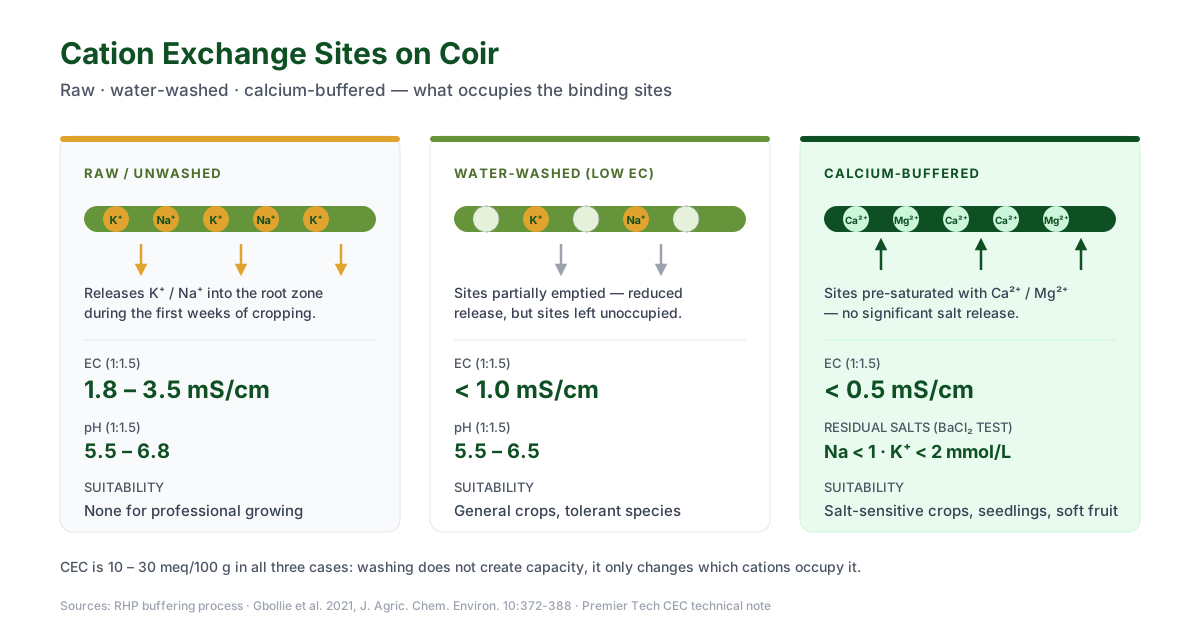
| Parameter | Raw / Unwashed Cocopeat | Water-Washed (Low EC) | Calcium-Buffered Cocopeat |
|---|---|---|---|
| Exchange sites occupied by | K⁺, Na⁺ (monovalent) | Partially emptied | Ca²⁺, Mg²⁺ (stabilised) |
| CEC (meq/100 g) | 10 – 30 (source-dependent) | 10 – 30 | 10 – 30, pre-saturated with Ca |
| pH (1:1.5 extraction) | 5.5 – 6.8 | 5.5 – 6.5 | 5.5 – 6.5 |
| EC (mS/cm, 1:1.5) | 1.8 – 3.5 | < 1.0 | < 0.5 |
| Sodium test (Barium Chloride) | High, variable | Variable | < 1 mmol/L Na |
| Potassium test (Barium Chloride) | High, variable | Variable | < 2 mmol/L K⁺ |
| Behaviour in first weeks | Releases K⁺/Na⁺ into root zone | Reduced release | No significant release; Ca/Mg release |
| Suitability | None for professional growing | General crops, tolerant species | Salt-sensitive crops, seedlings, soft fruit |
A published industrial benchmark for the buffered grade is the technical data sheet of Profile Coir Buffered (PROFILE Products LLC): it is described as treated with calcium nitrate to reduce sodium and potassium content for use in cultivation of salt-sensitive crops, with a specified pH of 5.5 – 6.5, EC below 0.5 mS/cm at 1:1.5 extraction, a Barium Chloride test result under 1 mmol/L Na and under 2 mmol/L K⁺, total porosity of 87 – 97%, air pore space of 15 – 25%, and an expansion ratio of 5:1 from compressed block to loose substrate.[5]
Those figures are the reference point against which an import spec should be written.[5] The physical measurements carry practical freight consequences as well: a 5:1 expansion ratio is what makes a compressed block programme logistically viable, and an air pore space above 15% is what distinguishes a stable structure from a substrate that slumps and compacts over a multi-month cycle.[5]
The pH range of coir as a growing medium is published as 5.5 to 6.5, consistent with the commercial buffered datasheet above.[7]
What the Controlled Trial Data Shows
The most directly applicable published trial on calcium nitrate buffering of cocopeat comes from Egerton University, Kenya (Gbollie, Mwonga & Kibe, 2021), published in the Journal of Agricultural Chemistry and Environment.[6]
The experiment was a greenhouse pot trial laid out as a 5 × 4 factorial completely randomised design:[6]
- Soaking durations: 12, 24, 36, 48 and 72 hours
- Calcium nitrate (Ca(NO3)2) levels: 0, 60, 100 and 150 g
Both the leachate and the treated cocopeat were examined for chemical properties, with analysis of variance at P ≤ 0.05.[6]
The reported outcomes:
- Addition of 100 g Ca(NO3)2 extracted significantly more K and Na into the leachate than the 0 g and 60 g treatments.[6]
- EC levels in the leachate increased with the applied Ca(NO3)2 level, while pH levels decreased.[6]
- In the treated cocopeat, 100 g Ca(NO3)2 combined with a 36-hour soaking duration significantly reduced K and Na and sufficiently supplemented Ca and N.[6]
- Strong negative correlations were found between Ca and Na, between Ca and K, and between Na and EC; strong positive correlations between Ca and N, and between Ca and EC.[6]
- Optimal reduction of K and Na by 78.44% and 92% respectively is achievable with 100 g of Ca(NO3)2 per 1.5 kg of cocopeat in 15 litres of water with a soaking duration of 36 hours.[6]
- Irrespective of Ca(NO3)2 level and soaking duration, after the cocopeat was washed, EC and pH values fell within their suitable ranges for use.[6]
The practical takeaway for a commercial spec is two-fold. First, buffering is not binary — dose and residence time determine the result, and 36 hours at 100 g per 1.5 kg is the trial-validated optimum reported.[6] Second, buffering and washing are complementary stages of one industrial process, not competing alternatives: the calcium displaces the monovalent cations, and the subsequent wash removes them.[2][6]
Specification Checklist for Importers
Any buffered cocopeat specification sheet presented for commercial supply should state, with both value and test method:
- EC, in mS/cm, with the extraction ratio declared (1:1.5 and 1:5 are not interchangeable).
- pH, with the extraction ratio declared.
- Sodium and potassium, expressed as Barium Chloride test results in mmol/L, not as a generic "washed" claim.
- CEC in meq/100 g.
- Air pore space and total porosity, with the measurement method named (e.g. NCSU porometer method).
- Expansion ratio and yield (L/kg and m³ per pallet), because these determine container economics.
- Buffering agent used (calcium nitrate, with or without magnesium) and any declared soak duration.
A supplier that cannot state the extraction ratio alongside an EC figure is quoting a number that cannot be verified by an incoming laboratory. That absence is the single most common gap in low-cost coir offers.
Sourcing High-Spec Cocopeat from Sidoarjo, Indonesia
PT Ridha Dua Keluarga operates a washed and calcium-buffered cocopeat programme from Sidoarjo, East Java, targeting commercial greenhouse, substrate blending, and nursery propagation customers who require a verifiable chemical specification rather than a bulk commodity claim.
Supplied formats include compressed 5 kg blocks and palletised configurations engineered for container optimisation, with specification sheets covering EC, pH, sodium and potassium test results, porosity, and expansion ratio.
Commercial buyers, substrate blenders, and importers requiring buffered coir at salt-sensitive crop specification can request the current technical data sheet and a sample lot report through the export desk at [email protected] or via the inquiry form on this site.
Related Keywords & Topics
Technical Citations & Referenced Standards
Standard testing methods, government regulations, and industry benchmarks cited in this document.
- [1]RHP (Netherlands) — Coir Products and the RHP Buffering Process
- [2]Greenhouse Grower — Washed, Low EC or Buffered: How to Specify Coco Substrate for Your Crop
- [3]HortGrow — Coco Coir as a Medium: CEC, Substrate Balancing and Precision Buffering
- [4]PT Growers and Consumers (Premier Tech) — CEC: Cation Exchange Capacity in Soilless Growing Media
- [5]PROFILE Products LLC — Technical Data Sheet: Profile Coir Buffered
- [6]Gbollie, S.N., Mwonga, S.M., Kibe, A.M. — Effects of Calcium Nitrate Levels and Soaking Durations on Cocopeat Nutrient Content. J. Agric. Chem. Environ. 10:372-388
- [7]OER Commons — Soilless Plant Growth Mediums (Introduction to Plant Science)
CBS Agronomy Notes
Sourcing 5kg Cocopeat Blocks for Commercial Agriculture?
Receive customized EC/pH lab certificates, container stuffing simulation (palletized or floor loaded), and FOB Tanjung Perak pricing.
Related Technical Notes
View all →
12 October 2026
DAFF Biosecurity Compliance: Exporting Cocopeat to Australia Without Costly Delays
BICON coir peat conditions, contaminant limits, container hygiene and khapra beetle exposure for exporting Indonesian cocopeat to Australia.

10 October 2026
Commercial Peat Moss Ban: Why European Greenhouses Are Switching to Buffered Cocopeat
How European and UK peat phase-out mandates are accelerating commercial greenhouse adoption of washed and buffered cocopeat blocks, and technical agronomic comparisons between sphagnum peat and coconut coir substrates.