Commercial Peat Moss Ban: Why European Greenhouses Are Switching to Buffered Cocopeat
CBS Agronomy & Export Technical Team
PT Ridha Dua Keluarga • Sidoarjo, East Java, Indonesia
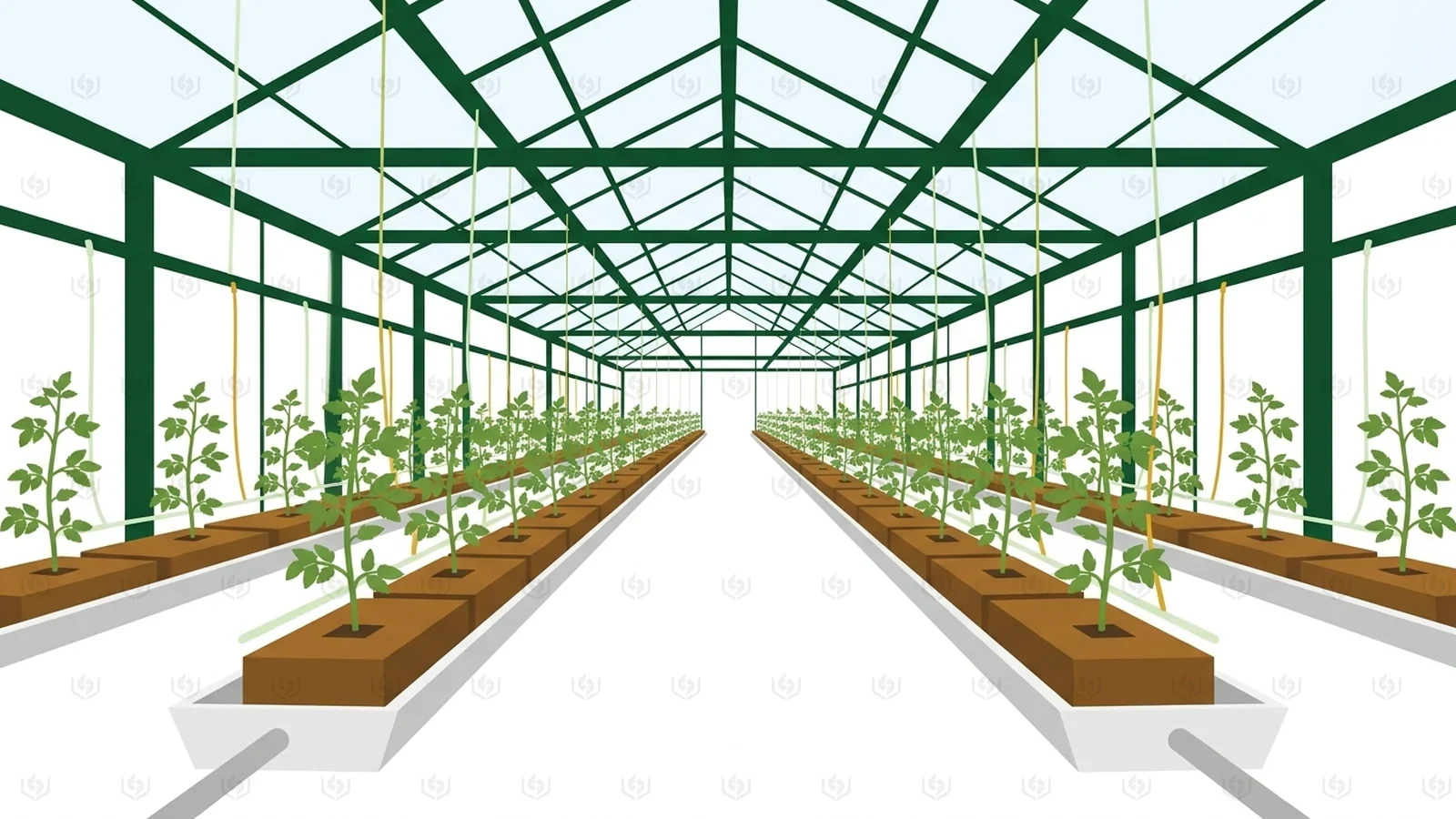
Technical Abstract & Key Parameters
How European and UK peat phase-out mandates are accelerating commercial greenhouse adoption of washed and buffered cocopeat blocks, and technical agronomic comparisons between sphagnum peat and coconut coir substrates.
Across the European Union and the United Kingdom, commercial horticulture is undergoing its most consequential substrate transition in half a century.
Legislative phase-outs of extracted sphagnum peat moss—accelerated by binding decarbonization targets, wetland ecosystem protections, and retailer ESG mandates—have forced professional growers, substrate blenders, and greenhouse operators to replace peat with renewable, high-performance growing media.
Among all alternatives (including wood fiber, perlite, bark, and composted green waste), processed coconut coir pith (cocopeat) has emerged as the definitive drop-in commercial replacement.
However, substituting peat with coir is not as simple as swapping bags. Raw coconut coir exhibits fundamentally different cation exchange dynamics, pH buffers, and salt profiles compared to acidic virgin peat.
Commercial growers who succeed in the transition understand the agronomic science of washed Low EC and calcium-buffered cocopeat.
The Regulatory Driver: Why Peat Extraction Is Ending
Peat bogs store nearly one-third of the world’s terrestrial carbon despite covering just 3% of global land area. Extracting virgin sphagnum peat destroys these delicate carbon sinks, releasing millions of metric tons of CO₂ annually into the atmosphere.
Governmental policies are eliminating peat from the supply chain:
- United Kingdom (DEFRA Mandates): Banning retail peat sales, with commercial horticulture mandated to transition to 100% peat-free substrates under strict compliance timelines.
- European Union (EU Nature Restoration Law): Member states (including the Netherlands, Germany, and France) are enforcing strict limits on wetland disturbance and incentivizing renewable organic substrates.
- Supermarket Chain Directives: Major European retail giants (Tesco, Marks & Spencer, Albert Heijn, Rewe) have enacted private ESG procurement rules requiring vegetable, herb, and soft fruit suppliers to certify peat-free or peat-reduced production.
For commercial greenhouse operators running tens of hectares of high-density tomato, sweet pepper, cucumber, strawberry, and nursery crops, finding a stable, scalable, and physically predictable substrate is no longer optional—it is a condition of market access.
Technical Comparison: Sphagnum Peat vs Raw Coir vs Buffered Cocopeat
To evaluate why high-spec cocopeat outperforms other peat alternatives, commercial agronomists compare physical and chemical behavior:
| Agronomic Parameter | Sphagnum Peat Moss | Raw / Unwashed Cocopeat | Washed & Buffered Cocopeat |
|---|---|---|---|
| Origin & Sustainability | Fossilized peat bog (Non-renewable) | Coconut agricultural byproduct (Renewable) | Coconut agricultural byproduct (Renewable) |
| Natural pH Range | 3.5 – 4.5 (Requires lime addition) | 5.5 – 6.8 | 5.8 – 6.5 (Optimal for root uptake) |
| Electrical Conductivity (EC) | Low (< 0.2 mS/cm) | High (1.8 – 3.5 mS/cm) | Ultra-Low (< 0.5 mS/cm) |
| Cation Exchange Sites | Hydrogen (H+) & trace nutrients | Saturated with Na+ & K+ | Stabilized with Ca2+ & Mg2+ |
| Air-Filled Porosity (AFP) | 10% – 15% (Prone to compaction) | 18% – 22% | 18% – 24% (Exceptional aeration) |
| Water Holding Capacity (WHC) | High (Hydrophobic when dried) | High (Hydrophilic; rewets instantly) | High (7–8x dry weight; instant re-wetting) |
| Structure Stability (Degradation) | Shrinks & slumps over 12 months | Stable fiber skeleton (Slow lignified breakdown) | Maintains structural aeration for multi-year cycles |
The Chemistry of Transition: Managing Cation Exchange Capacity (CEC)
The single biggest trap for growers transitioning from peat moss to coconut coir is Cation Exchange Capacity (CEC).
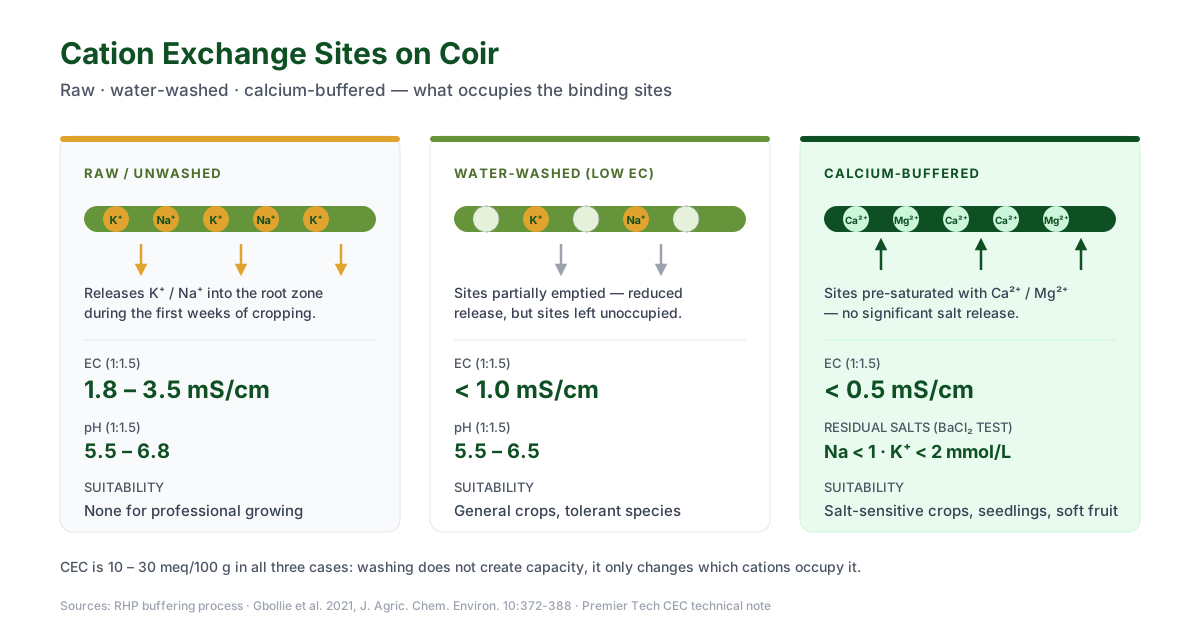
Peat moss is chemically inert and acidic; growers simply add agricultural lime (calcium carbonate) to bring pH up to 5.8–6.2 and start feeding standard liquid nutrient formulas.
Coconut coir, by contrast, is an active ion exchanger with a naturally high CEC (typically 60–130 meq/100g). Raw coconut husks develop in tropical soils where they absorb excessive amounts of Sodium (Na+) and Potassium (K+) into their negative exchange sites:
$$\text{Raw Coir Sites: } [\text{Coir}]^{-}\text{Na}^{+} + [\text{Coir}]^{-}\text{K}^{+}$$
If an unsuspecting grower introduces unwashed or improperly buffered coir into a commercial greenhouse fertigation system:
- Calcium & Magnesium Lockout: The coir matrix aggressively pulls Calcium ($Ca^{2+}$) and Magnesium ($Mg^{2+}$) out of the incoming nutrient solution to satisfy its exchange bonds.
- Sodium & Potassium Toxicity: In exchange, the coir releases bound Sodium ($Na^+$) and Potassium ($K^+$) into the root zone, causing rapid osmotic root burn, blossom end rot in tomatoes, and severe tip-burn in leafy crops.
The Industrial Solution: Controlled Calcium Buffering & Fresh Water Washing
To prevent this phenomenon, horticultural-grade cocopeat undergoes a precise dual-stage conditioning process at the production source:
- Fresh Water Washing: Flushes out unbound soluble salts, reducing baseline Electrical Conductivity from $>2.5\text{ mS/cm}$ down to $<0.5\text{ mS/cm}$ (measured under 1:5 volume dilution).
- Calcium Nitrate Conditioning (Buffering): The substrate is treated with a concentrated calcium nitrate solution. Divalent calcium ions ($Ca^{2+}$) displace monovalent sodium ($Na^+$) and potassium ($K^+$) ions from the coir fibers, which are then rinsed away.
When buffered cocopeat arrives at the greenhouse, its cation exchange sites are already stabilized. The grower's expensive liquid fertilizer reaches the plant roots directly without being stripped by the substrate.
Physical Aeration Advantages: Air-Filled Porosity (AFP) & Hydrophilic Rewetting
Beyond chemistry, processed cocopeat offers two massive physical advantages over traditional peat moss:
1. Superior Aeration & Root Respiration
Peat moss particles decompose and collapse into fine silt under continuous irrigation, dropping air-filled porosity (AFP) below 10% within 6–9 months. This creates waterlogged conditions that encourage root-rot pathogens such as Pythium and Phytophthora.
Cocopeat pith consists of durable, highly lignified cellular structures reinforced with short coconut fibers. It consistently maintains an AFP between 18% and 24%, providing ample oxygen to the root zone even under heavy daily drip irrigation cycles.
2. Elimination of Hydrophobic Dry-Backs
When peat moss dries out, it becomes hydrophobic. Rewetting dried peat requires chemical wetting agents and high-pressure flood irrigation.
Cocopeat is naturally hydrophilic. Even if an irrigation valve fails and the substrate completely dries out, cocopeat re-absorbs water instantaneously upon re-saturation without the need for artificial surfactants.
Logistics & Carbon Footprint: Compressed 5kg Blocks vs Bulk Peat Bales
Ocean freight economics also favor compressed cocopeat blocks over traditional loose or lightly compressed peat bales:
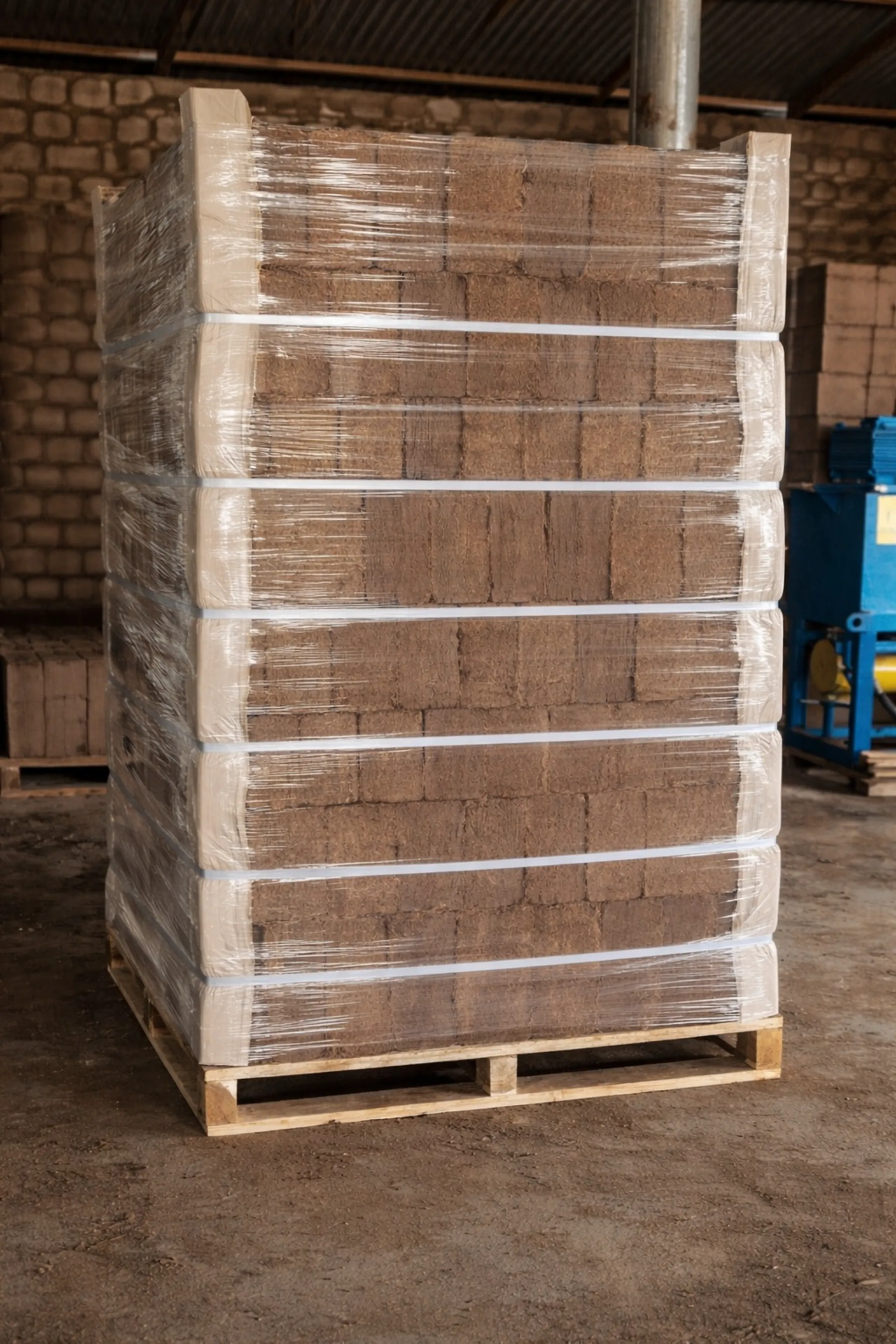
- Compression Factor: Sphagnum peat is typically compressed at roughly 2:1 into bulky 250-liter bales. Cocopeat blocks are compressed at 5:1 ratio under heavy hydraulic presses into dense 5kg bricks ($30\times30\times12\text{ cm}$).
- Container Efficiency: A single 40-foot High Cube (40HC) container carries 24 to 26 metric tons of compressed 5kg cocopeat blocks, expanding into over 350,000 to 390,000 liters of finished horticultural media at the destination nursery.
- Storage Space Reduction: Commercial blenders require 60% less dry warehouse storage space for raw compressed blocks compared to equivalent volumes of loose peat moss.
Sourcing High-Spec Cocopeat from Sidoarjo, Indonesia
Transitioning commercial greenhouse operations away from peat moss requires complete supply chain reliability, uniform batch-to-batch consistency, and verifiable laboratory parameters.
At Cocopeat Block Sidoarjo (CBS), produced by PT Ridha Dua Keluarga in East Java, Indonesia:
- Strict Low EC Verification: Guaranteed EC $<0.5\text{ mS/cm}$ (1:5 extraction) washed exclusively with monitored fresh groundwater.
- Controlled Moisture: Kept below 18%–20% to eliminate ocean transit mold development and weight variance.
- Standardized 5kg Export Blocks: High-expansion ratio yielding 70 to 75 liters of fluffy, highly aerated growing media per block.
- Strategic Export Port: Located under 45 km from Tanjung Perak International Container Terminal (Surabaya), ensuring rapid vessel departure without inland transshipment delays.
Commercial greenhouse operators, substrate blenders, and horticultural importers planning their peat-free transition can contact our export technical desk at [email protected] for full Certificate of Analysis (CoA) documentation, sample evaluation, and direct containerload (FCL) quotations.
Related Keywords & Topics
Technical Citations & Referenced Standards
Standard testing methods, government regulations, and industry benchmarks cited in this document.
- [1]UK Department for Environment, Food and Rural Affairs (DEFRA) — Commercial Peat Phase-Out Consultation and Policy
- [2]ISHS Acta Horticulturae 1305 — Evaluation of Coir as a Peat Alternative in Commercial Hydroponic Systems
- [3]Growing Media Europe (GME) — Substrate Sustainability and Decarbonization Roadmap
CBS Agronomy Notes
Sourcing 5kg Cocopeat Blocks for Commercial Agriculture?
Receive customized EC/pH lab certificates, container stuffing simulation (palletized or floor loaded), and FOB Tanjung Perak pricing.
Related Technical Notes
View all →
12 October 2026
Cation Exchange Capacity (CEC) in Coir Substrates: Calcium Buffering vs Plain Water Washing
Why raw cocopeat releases potassium and sodium during cultivation, and how calcium nitrate buffering compares with plain water washing on CEC, EC, and crop safety.

12 October 2026
DAFF Biosecurity Compliance: Exporting Cocopeat to Australia Without Costly Delays
BICON coir peat conditions, contaminant limits, container hygiene and khapra beetle exposure for exporting Indonesian cocopeat to Australia.