Commercial Greenhouse Tomato Substrate: Steering EC, Drainage Fractions, and K/Ca Ratios in Coir Grow Bags
CBS Agronomy & Export Technical Team
PT Ridha Dua Keluarga • Sidoarjo, East Java, Indonesia

Technical Abstract & Key Parameters
Technical agronomy guide to steering greenhouse tomatoes in coir grow bags: vegetative vs generative EC, drainage fractions, K/Ca balance, and BER prevention.
Commercial greenhouse tomato production represents one of the most demanding disciplines in Controlled Environment Agriculture (CEA). Across multi-hectare glasshouse complexes in the Netherlands, Ontario, Mexico, Spain, and Japan, growers must balance intensive yield targets (exceeding 60–80 kg/m² annually in modern high-wire systems) with high market expectations for soluble solids (°Brix), firmness, shelf stability, and visual uniformity.
Historically, the global tomato industry anchored its hydroponic operations in mineral stone wool (rockwool). Over the past decade, however, an accelerating combination of stringent European landfill regulations, mounting waste disposal tariffs (€40–€70 per metric ton in Western Europe and up to ¥40,000 per ton in Japan), and demanding ESG retail procurement mandates has propelled commercial growers toward compressed coconut coir grow bags (slabs and open-top containers).
Yet transitioning high-wire indeterminate tomato varieties (Solanum lycopersicum) to coconut coir is not a simple plug-and-play substitution. Coir is an active organic matrix with high cation exchange capacity (CEC), natural potassium-sodium loads, and distinct hydraulic capillary profiles. Successfully managing a tomato crop in coir slabs requires precise mastery of three interdependent levers: dynamic EC steering, controlled drainage fractions, and monovalent-to-divalent cation balancing (K⁺ vs. Ca²⁺).
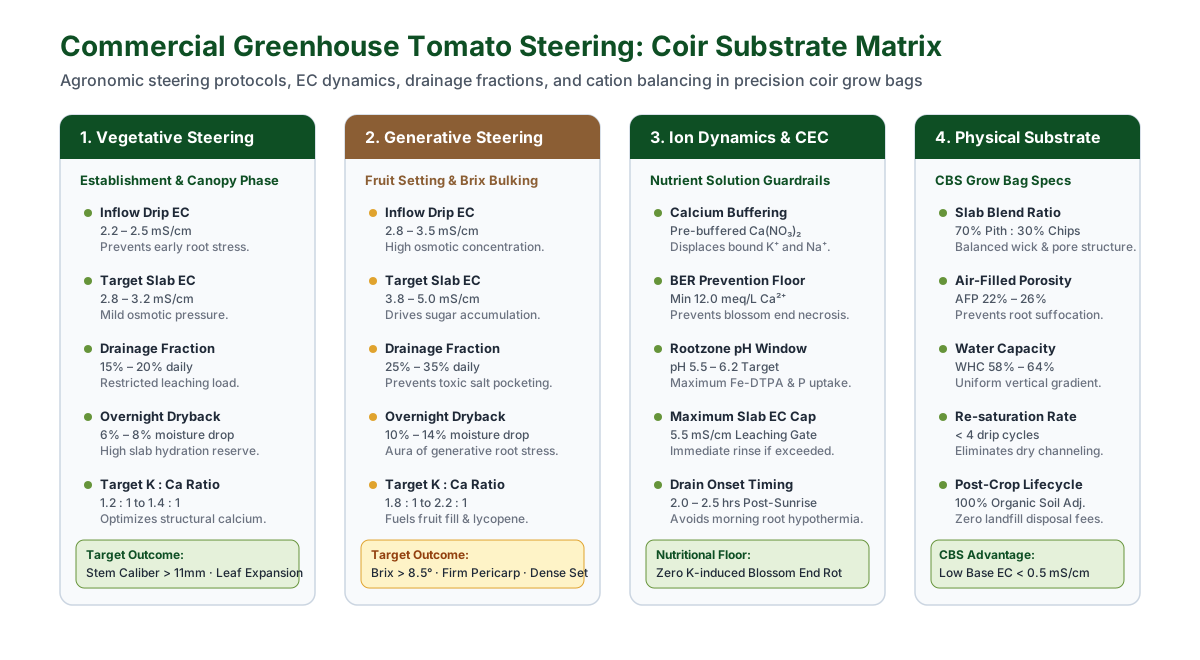
Physical Matrix & Aeration: Pith vs. Husk Chip Morphology
In high-wire tomato production, plants remain inside the same grow bag for 10 to 11 consecutive months. Over this extended cycle, irrigation systems deliver up to 3 to 5 liters of fertigation per plant daily during peak summer radiation. If a substrate degrades, compacts, or retains excess gravitational water, root zones experience rapid oxygen starvation (hypoxia), predisposing the crop to vascular collapse from Pythium ultimum or Phytophthora nicotianae.
To maintain structural longevity, commercial tomato grow bags must combine fine coir pith with structured coconut husk chips:
- The 70:30 Standard Slab Formulation: A high-performing tomato coir slab typically comprises 70% sieved coir pith (0–6 mm) and 30% coarse husk chips (8–12 mm). The fine pith establishes a uniform capillary network that distributes nutrient solution horizontally across the slab, while the angular husk chips act as non-compressible macropores that preserve gas exchange under heavy root biomass.
- Air-Filled Porosity (AFP): At container capacity (fully wetted and allowed to drain freely under gravity), a tomato coir slab must maintain an AFP between 20% and 26%. In comparison to pure rockwool, which can saturate up to 90% water by volume after initial wetting, coir naturally retains a higher volume of air in its inter-particle voids.
- Water-Holding Capacity (WHC): Target WHC should reside between 58% and 65% volume/volume. This dynamic reservoir gives growers greater buffer against irrigation valve failures or pump trips compared to perlite or pumice channels, without waterlogging the root apex.
- Wet-Back Dynamics: When subjected to intensive generative dryback regimens, mineral wool can form hydrophobic blind spots that resist re-wetting once moisture drops below 40%. Coconut coir retains exceptional capillary re-saturation characteristics, recovering uniform volumetric water content (VWC) within 3 to 4 standard irrigation shots.
Generative vs. Vegetative Crop Steering Dynamics
Crop steering is the deliberate manipulation of the root-zone climate (VWC, EC, shot volume, and dryback) and aerial greenhouse environment to direct plant assimilates either toward vegetative growth (stems, leaves, canopy building) or generative reproduction (flowering, fruit set, sugar concentration, ripening).
In coconut coir slabs, EC steering serves as the primary steering brake and accelerator:
Vegetative Steering Phase (Establishment & Early Canopy)
During initial transplanting and winter canopy development, the goal is to build strong plant architecture, thick stem calipers (10–12 mm), and large leaf surface areas capable of intercepting light.
- Inflow Drip EC: Held at moderate levels: 2.2 to 2.5 mS/cm.
- Target Slab EC: Stabilized between 2.8 and 3.2 mS/cm. Lower root-zone osmotic pressure lowers the energetic threshold for water uptake, promoting cell elongation and vigorous foliage expansion.
- Overnight Dryback: Restricted to 6% to 8%. Shorter intervals between morning shots prevent slab dehydration.
- Drainage Fraction: Maintained at 15% to 20% daily. The objective is gentle nutrient renewal without flushing away root-zone warmth during cold morning starts.
Generative Steering Phase (Fruit Load & Brix Bulking)
As fruit clusters set and swell, excessive vegetative vigor results in soft fruit, delayed ripening, weak trusses, and increased susceptibility to fungal leaf diseases. Elevating root-zone EC creates controlled osmotic stress that forces plants to channel assimilates into fruit carbohydrates, acids, and aromatic compounds:
- Inflow Drip EC: Elevated to 2.8 to 3.5 mS/cm (or up to 4.0 mS/cm for specialized cocktail and cherry varieties).
- Target Slab EC: Driven up to 3.8 to 5.0 mS/cm. High osmotic pressure restricts cell expansion, concentrating soluble solids (°Brix > 8.5° in cherry lines and > 5.5° in large beefsteak tomatoes) and producing thick, firm pericarp walls.
- Overnight Dryback: Expanded to 10% to 14% (and occasionally 15% in fully automated venlo houses). Irrigation ceases 2.5 to 3 hours before sunset, forcing roots to search for moisture as slab temperature cools.
- Drainage Fraction: Increased to 25% to 35%. Higher drain percentages are required to prevent localized salt crystallization and flush out non-assimilated counter-ions.
| Parameter / Metric | Vegetative Steering Window | Generative Steering Window | Leaching & Hazard Threshold |
|---|---|---|---|
| Inflow Drip EC | 2.2 – 2.5 mS/cm | 2.8 – 3.5 mS/cm | > 4.2 mS/cm (Root Burn Risk) |
| Slab Equilibrium EC | 2.8 – 3.2 mS/cm | 3.8 – 5.0 mS/cm | > 5.5 mS/cm (Immediate Rinse Needed) |
| Daily Drainage Fraction | 15% – 20% | 25% – 35% | < 10% (Accumulation Hazard) |
| Overnight Dryback | 6% – 8% VWC | 10% – 14% VWC | > 18% (Root Desiccation) |
| First Drain Timing | 1.5 – 2.0 hrs post-sunrise | 2.5 – 3.0 hrs post-sunrise | Prior to sunrise (Thermal Shock) |
| Last Irrigation Shot | 1.5 – 2.0 hrs pre-sunset | 2.5 – 3.5 hrs pre-sunset | After dark (Edema / Guttation) |
| Target K : Ca Molar Ratio | 1.2 : 1 – 1.4 : 1 | 1.8 : 1 – 2.2 : 1 | > 2.5 : 1 (Severe BER Danger) |
| Root-zone pH Window | 5.6 – 6.0 | 5.8 – 6.2 | < 5.2 (Ca/Mg Lock) / > 6.6 (Fe Drop) |
Cation Dynamics: Cation Exchange Capacity (CEC) and the K/Ca Antagonism
The single greatest agronomic obstacle when switching commercial tomatoes from inert rockwool to coconut coir is understanding the organic Cation Exchange Capacity (CEC) of the coir matrix.
Raw, unwashed coconut pith has a natural CEC ranging from 60 to 130 meq/100g. In its untreated state, these negative exchange sites on the coir complex are heavily saturated with monovalent potassium (K⁺) and sodium (Na⁺) cations. Conversely, the exchange complex has a naturally strong chemical affinity for divalent cations, specifically calcium (Ca²⁺) and magnesium (Mg²⁺).
The Blossom End Rot (BER) Mechanism in Coir
If an inexperienced grower hydrates raw or inadequately washed coir with a standard rockwool nutrient recipe, an immediate cation exchange reaction occurs:
$$\text{Coir}^{[-]} \cdot 2\text{K}^{+} + \text{Ca}^{2+} \longrightarrow \text{Coir}^{[-]} \cdot \text{Ca}^{2+} + 2\text{K}^{+}$$
The coir matrix locks up dissolved calcium from the drip solution, stripping free Ca²⁺ ions out of the root zone, while displacing vast quantities of potassium into the rhizosphere.
Tomatoes have an immense demand for calcium during early cell division in developing fruit clusters (10 to 14 days after flower pollination). Calcium is an immobile element translocated almost exclusively via xylem transpiration flow. Under high temperatures or low transpiration, combined with coir-induced calcium immobilization and intense potassium antagonism ($K^+$ outcompeting $Ca^{2+}$ at root transporter channels), calcium cannot reach the distal end of the expanding fruit. Cell walls collapse, leading to irreversible Blossom End Rot (BER) that can destroy 20% to 50% of the harvestable crop.
Industrial Calcium Buffering Protocols
To eradicate this physiological failure mode before grow bags reach the greenhouse floor, export-grade coir must undergo industrial chemical buffering at the manufacturing plant:
- Calcium Nitrate Immersion: Saturated coir pith is dosed with a concentrated solution of industrial calcium nitrate ($\text{Ca(NO}_3\text{)}_2$) and allowed to react for designated dwell periods.
- Ion Displacement & Flushing: Divalent $\text{Ca}^{2+}$ cations occupy the complex exchange sites, forcing native monovalent $\text{K}^+$ and $\text{Cl}^-$ into solution. The coir is subsequently washed with clean, low-salinity deep well water until electrical conductivity drops below 0.5 mS/cm (1:1.5 extraction method).
- Nutrient Recipe Calibration: In commercial fertigation, agronomists maintain a minimum calcium floor of 12.0 to 14.0 meq/L Ca²⁺ in the inflow tank, keeping the K:Ca ratio tightly constrained between 1.2:1 (vegetative) and 2.0:1 (generative).
Irrigation Management: Timing, Leaching, and Shot Volumes
Irrigating tomato slabs in coir differs fundamentally from open-field soil or mineral rockwool management. Precision greenhouse controllers utilize solar radiation integration (accumulating Joules/cm²) to trigger drip cycles:
- Radiation Sum Triggers: Rather than rigid clock intervals, irrigation shots are triggered every 100 to 140 J/cm² of accumulated global solar radiation.
- Shot Volume Precision: Individual shot sizes are calibrated to 100 to 150 ml per dripper (equivalent to 2.5% to 3.5% of total slab volume). Smaller, frequent pulses prevent saturation channeling and encourage deep, three-dimensional root branching throughout the entire bag depth.
- The First Drain Window: The first drain of the day should never occur on the first morning shot. Growers should allow the plant to transpire and drop slab moisture by 2% to 4% after sunrise, with drain appearing only on the 3rd or 4th shot (typically 2.0 to 2.5 hours post-sunrise). This avoids cooling the root zone while greenhouse air temperatures are still climbing.
- Drainage EC Surveillance: The EC of collected drain runoff should register between 0.5 and 1.0 mS/cm higher than the incoming drip solution. If drain EC spikes more than 1.5 mS/cm above drip EC, localized salt accumulation has crossed the safe threshold, requiring a 10% increase in drainage fraction on subsequent irrigation cycles.
Substrate Economics: Coir Grow Bags vs. Rockwool Slabs
From a financial and operational standpoint, commercial CEA facilities are increasingly compelled by the total cost of ownership (TCO) advantages offered by coir grow bags:
- Logistics & Warehousing Footprint: Rockwool slabs are pre-expanded, delicate mineral blocks that occupy vast freight volumes and cannot be heavily compressed without shattering fiber integrity. In contrast, coconut coir grow bags are compressed at a 5:1 ratio into dry, rigid planks enclosed in co-extruded UV-treated plastic sleeves. A single 40ft High Cube shipping container accommodates up to 24 metric tons of compressed slabs (approximately 5,000 to 6,000 slabs capable of hydrating into 80–100 m³ of finished media).
- Elimination of Hazardous Waste Disposal: Mineral rockwool is non-biodegradable and cannot be land-applied. In European and Japanese agricultural districts, growers must pay certified waste haulers up to €60 per ton to truck used slabs to designated aggregate dumps or high-temperature furnaces. Coir grow bags, being 100% organic cellulose and lignin, are shredded post-harvest and incorporated directly into regional open-field soils, orchards, or commercial compost production at zero tipping fee.
- Biosecurity Compliance: Sourcing coir grow bags from certified facilities operating on fully paved, concrete drying pads ensures freedom from agricultural soil contamination, weed seeds, and quarantine parasitic nematodes (Meloidogyne, Globodera), fulfilling stringent USDA APHIS, EU Plant Health, and Japanese MAFF import standards without costly port fumigation delays.
Sourcing High-Spec Cocopeat from Sidoarjo, Indonesia
Precision hydroponic tomato cultivation demands growing media engineered to exacting physical and chemical tolerances. Substandard coir exhibiting erratic salt loads, residual sand contamination, or unpredictable moisture retention poses direct catastrophic risks to high-wire crop steering and yield predictability.
PT Ridha Dua Keluarga supplies commercial greenhouse operations, substrate manufacturers, and international distributors with premium washed low EC cocopeat grow bags and blocks from our Sidoarjo facility in East Java, Indonesia.
- Direct Maritime Proximity: Operating 25 km from Port of Tanjung Perak (Surabaya), eliminating internal transit delays and preserving strict moisture specifications (<18–20%).
- Sanitary Production Flooring: 100% concrete-paved washing pads and deep-well water processing ensure absolute zero soil contamination and full biosecurity compliance for Australia (DAFF), Japan (MAFF), Europe, and North America.
- Rigorous Chemical Quality Control: Low EC guarantees (<0.5 mS/cm) and pre-buffered calcium nitrate formulations calibrated specifically for commercial solanaceous and soft-fruit crops.
- Custom CEA Packaging: Compressed 5kg blocks, 650g briquettes, and custom co-extruded grow bag slabs (70:30 pith-to-chip blends) manufactured to international greenhouse specifications.
For technical data sheets, laboratory batch analyses, or containerload export quotations, contact our agronomy export desk directly at [email protected] or submit an inquiry through our commercial portal.
Related Keywords & Topics
Technical Citations & Referenced Standards
Standard testing methods, government regulations, and industry benchmarks cited in this document.
- [1]Wageningen University & Research (WUR) — Precision Hydroponic Substrates & Crop Steering
- [2]International Society for Horticultural Science (ISHS) — Coir Substrate Dynamics in Protected Tomato Cultivation
- [3]University of Arizona Controlled Environment Agriculture Center (CEAC) — Hydroponic Tomato Nutrient Solutions & EC Steering
- [4]EPAGMA & Growing Media Europe — Substrate Physics and Recyclability Standards
CBS Agronomy Notes
Sourcing 5kg Cocopeat Blocks for Commercial Agriculture?
Receive customized EC/pH lab certificates, container stuffing simulation (palletized or floor loaded), and FOB Tanjung Perak pricing.
Related Technical Notes
View all →
9 November 2026
USDA APHIS Biosecurity Compliance: Meeting North American Plant Health Standards for Imported Compressed Coir
How US importers clear compressed coir: APHIS soil rule, ACIR lookup, ISPM 15 pallet marking, phytosanitary documents and the spec controls that avoid port holds.

2 November 2026
MAFF Japan Quarantine Protocols: Fumigation, Heat Treatment, and Nematode-Free Certification for Coir Substrate Imports
Guide to MAFF Japan biosecurity for imported cocopeat: Article 7 soil prohibition, nematode testing, methyl bromide fumigation, and Barantan certification.