USDA APHIS Biosecurity Compliance: Meeting North American Plant Health Standards for Imported Compressed Coir
CBS Agronomy & Export Technical Team
PT Ridha Dua Keluarga • Sidoarjo, East Java, Indonesia

Technical Abstract & Key Parameters
How US importers clear compressed coir: APHIS soil rule, ACIR lookup, ISPM 15 pallet marking, phytosanitary documents and the spec controls that avoid port holds.
North American controlled-environment growers are moving volume from rockwool and peat into coir. For the importer, the commercial risk is not the price per tonne. It is a container held at the port while an inspector decides whether the cargo contains soil, pests or non-compliant wooden packaging. A hold of a few days means demurrage, missed planting windows and a damaged relationship with the grower.
This article maps the US import path for compressed coir blocks and shows which exporter-side controls reduce the chance of a hold. It is a buyer-side checklist, not legal advice: APHIS requirements change by commodity and origin, so every importer must confirm the current entry in the APHIS ACIR database before booking.
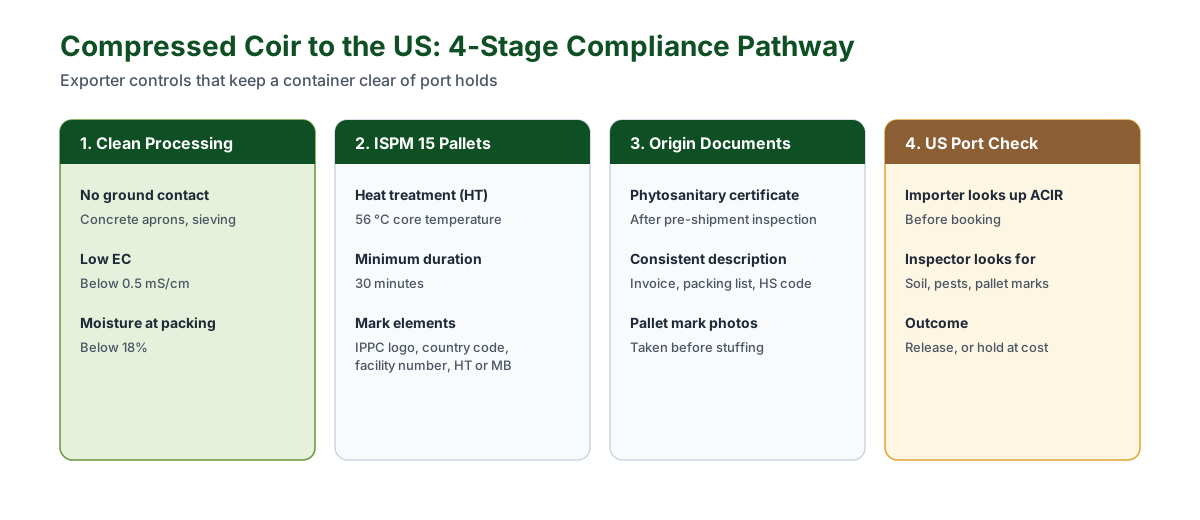
Where APHIS Draws the Line: Soil, Plants and Packaging
Three separate APHIS rules touch a coir shipment. They are often confused, so it helps to treat them separately.
- Soil rule. APHIS states that soil from countries other than Canada is prohibited without a permit or USDA-approved treatment, and that untreated soil cannot be authorised for import unless it goes to an APHIS-inspected facility under a valid permit. Coir is a plant-derived medium, not soil. But a block contaminated with mineral soil from an unpaved drying yard can be treated by an inspector as soil-bearing cargo. This is the single most avoidable failure.
- Plant product rule. Requirements for plant products depend on the commodity and the country of origin, and are published in ACIR. The importer should look up the specific entry, confirm whether a permit or phytosanitary certificate is demanded, and keep the printout with the shipping file. APHIS notes that permit processing through eFile can take up to two months for plant imports, so documentation must be sorted before the cargo is booked, not after it sails.
- Wood packaging rule. All regulated wood packaging (pallets, skids, crates, dunnage) entering the US must be treated and carry the ISPM 15 mark. APHIS lists the mark elements: the IPPC logo, a two-letter country code, a unique facility number, and the treatment code (HT for heat treatment, MB for methyl bromide). Heat treatment means a minimum wood core temperature of 56 °C for at least 30 minutes. Non-compliant wood packaging is refused entry, regardless of how clean the coir inside is.
One point of caution: APHIS pages that mention coconut husks or coconut fibre in the context of "plants in growing media" describe an exception for epiphytic plants shipped in that media. That is a different case from commercial coir shipped as a stand-alone substrate. Do not cite that exception as proof that coir is exempt.
Compliance Checkpoints for Compressed Coir
| Checkpoint | Who controls it | What the inspector looks for | Exporter-side control |
|---|---|---|---|
| Mineral soil contamination | Exporter | Soil, sand or clay particles in blocks or loose pith | Concrete drying aprons, de-sanding sieves, no ground contact |
| Live pests, insects, larvae | Exporter | Live organisms in blocks, bags, pallets | Dry, sealed packing; visual inspection before loading |
| Wood packaging | Exporter / pallet supplier | ISPM 15 mark: IPPC logo, country code, facility number, HT or MB | Buy marked HT pallets (56 °C core, 30 min); keep supplier certificate |
| Origin phytosanitary document | Exporting-country plant protection authority | Certificate matches the cargo and consignee | Pre-shipment inspection request; consistent product description |
| Import entry requirement | Importer | Match against the current ACIR entry | Importer prints ACIR entry; exporter aligns the documents to it |
| Substrate quality (not a customs item) | Exporter | Not inspected, but drives rejection risk and grower acceptance | Low EC and controlled moisture, documented per lot |
Why Process Hygiene Is the Real Compliance Tool
Port inspectors cannot test agronomy, but they can see dirt. The practical lesson from the Japan and Australia protocols (covered in our articles on MAFF quarantine and DAFF biosecurity) applies equally to the US: a facility that keeps coir off bare ground from washing through baling gives the importer a clean file. A facility that dries pith on open earth gives the importer a gamble.
For substrate quality, the specification the grower actually uses should be written in the contract and verified per lot, not assumed:
- Electrical conductivity: below 0.5 mS/cm for washed low EC grades (1:1.5 extraction).
- Moisture at packing: below 18%, which limits mould during the sea voyage and stops condensation damage inside the container.
- Physical form: uniform 5 kg compressed blocks, which keep palletised loads stable and simplify inspector sampling.
Moisture matters for compliance too. A block that sweats during transit grows surface mould, and mould found at inspection is likely to trigger questions that a dry block never raises.
Documentation Pack to Agree Before Booking
Importers should insist on the following in the purchase contract, so that nothing is improvised at the port:
- Commodity description and HS code consistent across the invoice, packing list and phytosanitary certificate.
- Origin phytosanitary certificate issued by the Indonesian plant protection authority after pre-shipment inspection.
- ISPM 15 certificate or supplier declaration for every pallet, with the mark photographed before stuffing.
- Photographs of the container loading, seal number and pallet marks.
- A product specification sheet (EC, moisture, block weight) per lot.
- A named customs broker on the US side who has the current ACIR entry in hand.
This pack costs little and cuts the number of questions at the port. It also gives the importer evidence if a lot is challenged.
Practical Risk Ranking for a First US Shipment
For a first container, rank the risks in this order and spend effort accordingly: wooden packaging marks first (an easy and fatal failure), then soil contamination (the process-hygiene question), then document consistency, then the entry-requirement lookup, which the importer's broker should close before booking. Quality parameters do not decide clearance, but they decide whether the second order is placed.
Read this article together with our cocopeat producer in Sidoarjo overview if you are comparing origins, and with the MAFF and DAFF articles in this series if the same cargo programme must serve several destination markets.
Sourcing High-Spec Cocopeat from Sidoarjo, Indonesia
PT Ridha Dua Keluarga produces washed, low EC compressed coir blocks in East Java with shipping access through Tanjung Perak, Surabaya. Our export file approach for North American buyers covers:
- Paved-surface processing: washing, curing, sieving and baling without ground contact, to remove the soil-contamination risk at source.
- Low EC (<0.5 mS/cm) and moisture (<18%) documented per lot.
- Marked heat-treated pallets with the ISPM 15 mark photographed before loading.
- Document alignment with the origin phytosanitary certificate and the importer's ACIR entry.
For specification sheets, lot documentation and container quotations, write to [email protected] or submit an inquiry through our commercial desk.
Related Keywords & Topics
Technical Citations & Referenced Standards
Standard testing methods, government regulations, and industry benchmarks cited in this document.
- [1]USDA APHIS — Agricultural Commodity Import Requirements (ACIR) and How To Import Plants and Plant Products
- [2]USDA APHIS — Foreign Soil Not Treated at the Port of Entry
- [3]USDA APHIS — Import ISPM 15-Compliant Wood Packaging Material into the United States
- [4]USDA APHIS — Plants with Special Requirements and Prohibited Plants
CBS Agronomy Notes
Sourcing 5kg Cocopeat Blocks for Commercial Agriculture?
Receive customized EC/pH lab certificates, container stuffing simulation (palletized or floor loaded), and FOB Tanjung Perak pricing.
Related Technical Notes
View all →
5 November 2026
Commercial Greenhouse Tomato Substrate: Steering EC, Drainage Fractions, and K/Ca Ratios in Coir Grow Bags
Technical agronomy guide to steering greenhouse tomatoes in coir grow bags: vegetative vs generative EC, drainage fractions, K/Ca balance, and BER prevention.

2 November 2026
MAFF Japan Quarantine Protocols: Fumigation, Heat Treatment, and Nematode-Free Certification for Coir Substrate Imports
Guide to MAFF Japan biosecurity for imported cocopeat: Article 7 soil prohibition, nematode testing, methyl bromide fumigation, and Barantan certification.