Strawberry Substrate Guide: Coir Slabs and Grow Bags for Tabletop Soft-Fruit Production
CBS Agronomy & Export Technical Team
PT Ridha Dua Keluarga • Sidoarjo, East Java, Indonesia

Technical Abstract & Key Parameters
Strawberry on coir: published EC, pH, drainage and irrigation ranges, chip-to-dust ratio effects, reuse across seasons, and how coir compares with peat blends.
Strawberry is one of the largest soilless crops grown on coir. Growers in elevated tabletop systems want a substrate that holds enough water for shallow roots, drains fast enough to keep oxygen at the root, and stays predictable over several seasons. Coir meets that brief, but only when it is washed, buffered and irrigated for its own physical behaviour.
This article collects published strawberry trial data on coir, shows where it matches peat-based blends and where it does not, and lists what an importer should ask a coir supplier before ordering. Most of the numbers come from Korean slab trials, so treat them as reference ranges, not universal setpoints.
Why Coir Fits Tabletop Strawberry
Tabletop and gutter systems use small substrate volumes per plant. Small volumes amplify every mistake: a saline batch, a blocked dripper or an over-dry slab shows up within days. A coir slab or bag gives a consistent starting point, high air-filled porosity and an easy drain path.
Trial evidence is broadly supportive:
- In a Norwegian reuse study, strawberry yield was satisfactory and comparable across coir, peat and wood fiber. Peat and wood fiber were slightly higher in year one, while coir yield stayed relatively stable when the same substrate was reused.
- An Italian substrate and container trial (cv. 'Elsanta') found total plant production similar across peat and coconut coir, and plants on coir produced more roots than those on peat.
- A greenhouse trial of nine media (cv. 'Albion') reported total yield of 8.93 to 11.24 kg/m². The best result came from a peat/wood fiber/perlite blend. Coir and wood fiber favoured Brix, and 100% coir showed the fewest Pythium oospores, although the difference to peat/wood fiber blends was not statistically significant.
Read honestly, coir is not always the highest-yielding option in year one. Its case rests on predictability, drainage, reuse stability and disease pressure, not on a yield gap.
Published Reference Ranges
| Parameter | Reported value | Context |
|---|---|---|
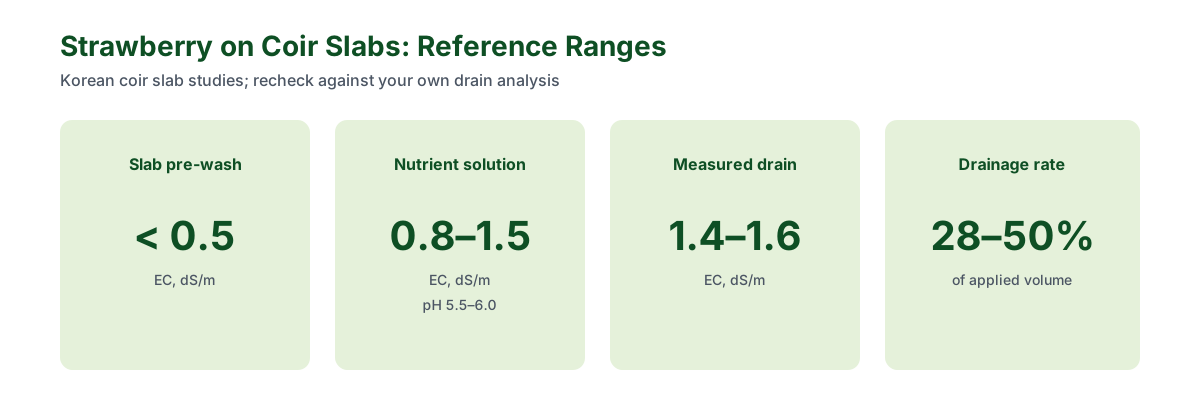
| Slab EC before planting | below 0.5 dS/m | Slabs washed and buffered in a Korean slab-volume trial |
| Nutrient solution EC | 0.8 to 1.5 dS/m | Coir slab hydroponics, adjusted by growth stage |
| Nutrient solution pH | 5.5 to 6.0 | Same Korean programme |
| Measured drain EC | 1.4 to 1.6 dS/m | Across slab volumes in the same trial |
| Drainage rate | 28 to 50% | Load-cell scheduled irrigation trial |
| Daily irrigation per plant | 90 to 150 mL | Rising from December to February in that trial |
| Greenhouse media EC (SME) | 2.0 mmhos/cm or less | Practical guidance for greenhouse strawberry, pH 6.0 to 6.2 |
The same-crop spread between 0.8 and 1.5 dS/m in the feed is wide on purpose. Growers raise or lower it by growth stage and weather. Our EC guide explains why a low starting EC in the slab matters before any of this steering begins.
Chip-to-Dust Ratio Controls Water Behaviour
Coir is not a single material. Fine pith (dust) holds water. Chips add air and speed drainage. In the Korean slab-volume trial, slabs with a 5:5 chip-to-dust ratio at 12 cm height showed the highest drainage ratio and the lowest retained water volume, compared with 0:10 dust-only slabs. The authors conclude that irrigation can be steered through the chip ratio.
For a buyer this has a practical meaning. Two lots that are both "low EC cocopeat" can behave very differently in a slab. Ask for the chip-to-dust ratio, not only EC and moisture, and match it to your irrigation frequency.
Coir also drains quicker than the crop can use the water. Industry commentary notes that strawberries on coir generally need more frequent irrigation than on peat-based mixes, which release water more slowly. One peat-blend supplier reports its own two-year trial outperforming coir in yield and berry size with less leaching. That is a vendor result and has not been replicated in the peer-reviewed trials above, but the irrigation point is consistent with the drainage data.
Pre-Use Preparation
Washing and buffering decide whether the first weeks go well.
- Check supplier EC per lot. Target below 0.5 dS/m before planting, as in the trials above.
- Buffer with calcium where the lot calls for it. Our article on calcium buffering versus plain washing explains why untreated coir can bind calcium and release potassium and sodium.
- Drill drainage holes in the slab base. The Korean trials used four 2 cm holes.
- Run a first drain test. Drain pH and EC should track the feed. In a pot-volume trial, coir drainage kept pH and EC close to the nutrient solution throughout cultivation.
- Set irrigation by weather. One trial applied 320 mL per dripper on sunny days and 50% of that on cloudy days.
Reuse Across Seasons
Reuse is where coir has the clearest advantage in the Frontiers data. Berry yield from plants in coir stayed relatively stable across reused substrate, while peat and wood fiber showed weak evidence of declining yield potential in years two and three. The reduction was small and not statistically different from coir, so the safe statement is that coir reuse held up, not that it beat peat.
Reuse needs sanitation and drain analysis. Salt accumulation and pathogen carry-over are the practical risks, and neither is solved by the substrate alone.
Buyer Checklist
| Ask the supplier | Why it matters |
|---|---|
| EC and pH per lot, with test method | Slab target below 0.5 dS/m |
| Chip-to-dust ratio | Sets drainage and retained water |
| Moisture and compression format | Affects freight and hydration step |
| Washing and buffering method | Determines calcium and potassium behaviour |
| Origin and phytosanitary documents | Import clearance, see our USDA APHIS article |
Limits of the Evidence
Most strawberry coir data comes from Korean hydroponic slab trials with specific cultivars ('Kuemsil', 'Sulhyang', 'Santa') and climate. European and North American growers use different cultivars, longer days and different water quality. Use the ranges above as a starting frame for your own trial, not as a guarantee. No yield figure here should be read as a promise for another site.
Growers who need a processing partner can start with export-grade coir blocks made in Sidoarjo, then run a small-batch trial before committing to a full programme.
Sourcing High-Spec Cocopeat from Sidoarjo, Indonesia
PT Ridha Dua Keluarga produces washed, low EC compressed coir blocks in East Java, shipped through Tanjung Perak, Surabaya. For strawberry and soft-fruit programmes we can supply:
- Per-lot specification sheets with EC and moisture documented.
- Compressed block formats for rehydration into slabs or grow bags on your side.
- Container-level quotations so freight enters your cost model as a real number.
Write to [email protected] with your crop, annual volume, preferred chip-to-dust ratio and destination port.
Related Keywords & Topics
Technical Citations & Referenced Standards
Standard testing methods, government regulations, and industry benchmarks cited in this document.
- [1]Frontiers in Plant Science 14:1307240 — Reuse of coir, peat, and wood fiber in strawberry production
- [2]Acta Horticulturae 1389 — Characterization of selected growing media for greenhouse-grown strawberries
- [3]Acta Horticulturae 1156 — Effect of substrate and container type in the strawberry soilless cultivation
- [4]Horticultural Science and Technology — Effect of Coir Slab Volumes on the Growth and Yield of Strawberry
- [5]Horticultural Science and Technology — Analysis of Evapotranspiration using a Load Cell and Water Balance in Strawberry Hydroponics
- [6]Inside Grower — Dialing in On Strawberries
CBS Agronomy Notes
Sourcing 5kg Cocopeat Blocks for Commercial Agriculture?
Receive customized EC/pH lab certificates, container stuffing simulation (palletized or floor loaded), and FOB Tanjung Perak pricing.
Related Technical Notes
View all →
12 November 2026
Cocopeat vs Rockwool: Total Cost of Ownership, Disposal and Water Use for Commercial Greenhouses
Cocopeat vs rockwool for commercial greenhouses: purchase price is the smallest line. Compare freight, drain recirculation, nutrient loss and disposal cost.

9 November 2026
USDA APHIS Biosecurity Compliance: Meeting North American Plant Health Standards for Imported Compressed Coir
How US importers clear compressed coir: APHIS soil rule, ACIR lookup, ISPM 15 pallet marking, phytosanitary documents and the spec controls that avoid port holds.