Ocean Freight Economics: How 5:1 Hydraulic Compression and 40ft HC Palletization Dictate Landed Substrate Cost
CBS Agronomy & Export Technical Team
PT Ridha Dua Keluarga • Sidoarjo, East Java, Indonesia
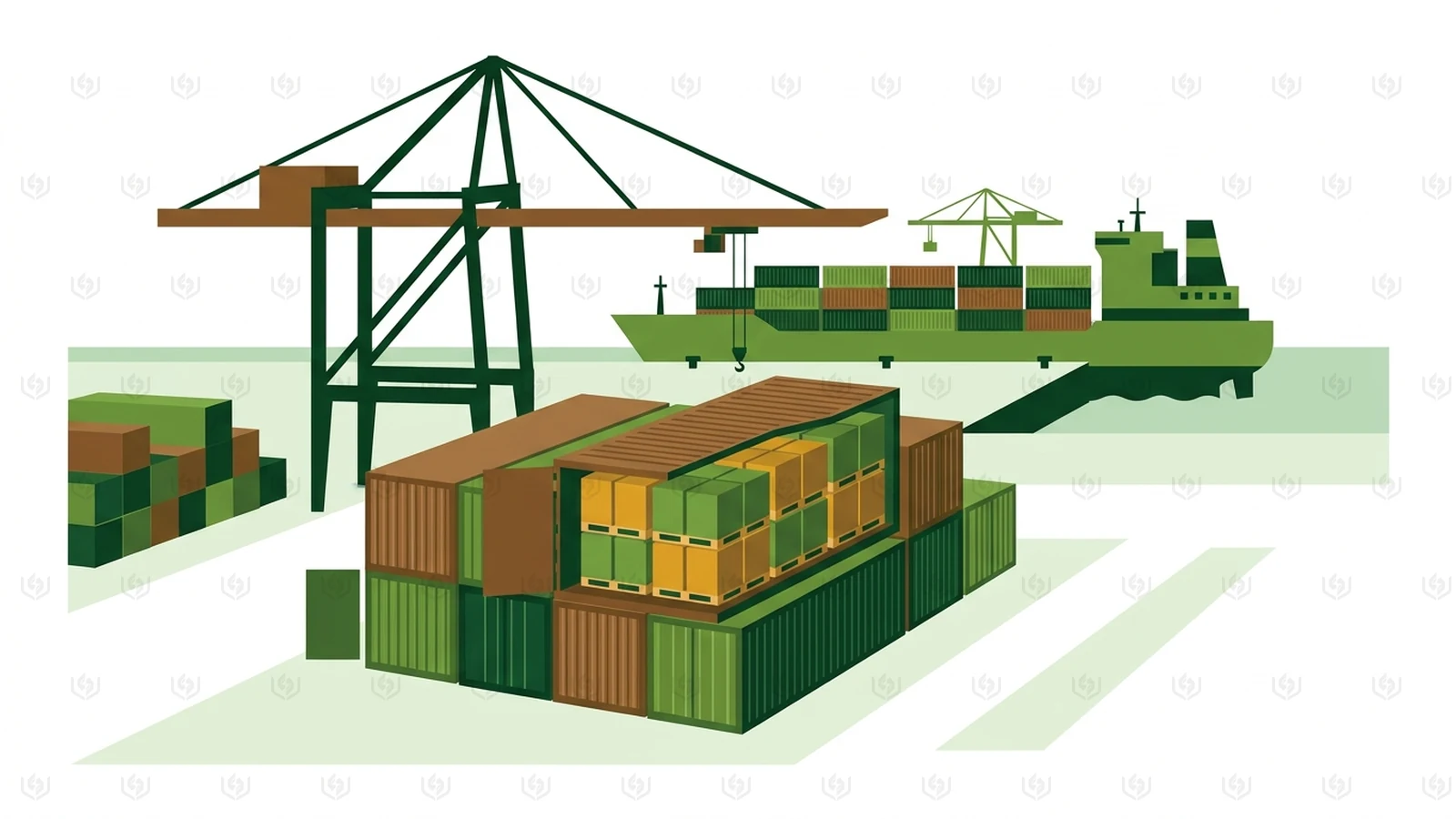
Technical Abstract & Key Parameters
B2B commercial guide analyzing ocean freight economics for 5kg cocopeat blocks: 5:1 hydraulic compression, volumetric yield vs peat moss, 40ft HC palletization layouts, and demurrage-reducing de-vanning strategies.
For commercial greenhouse operators, substrate blenders, and horticultural distributors importing growing media across international sea routes, raw material purchase price (FOB) represents only part of the procurement equation. Ocean freight, port handling charges, demurrage risk, and warehouse de-vanning labor often determine whether a substrate program remains commercially viable.
In an era of volatile ocean shipping rates and extended transit corridors around southern shipping capes, coconut coir pith holds a decisive structural logistics advantage over traditional horticultural media: high mechanical compressibility.
While raw or baled peat moss and wood fibers hit volumetric cubic capacity ("cube out") in shipping containers at low total mass, coconut coir can be compressed mechanically at a 5:1 ratio into dense 5kg blocks without compromising cellular moisture retention or pore structure upon reconstitution.
This technical analysis models the landed freight economics of 5kg cocopeat blocks, compares volumetric yields against traditional baled substrates, examines 40ft High Cube container palletization engineering, and calculates the exact tipping points between palletized and floor-loaded consignments.
The Densification Advantage: 5:1 Hydraulic Compression vs Baled Peat
Growing media freight costs are governed by the relationship between cargo volume and cargo mass. Most international ocean container lines charge per container box (Forty-Foot Equivalent Unit, or FEU), meaning the cost per cubic meter of usable, rehydrated growing media is dictated entirely by how many expandable liters can fit into a standard 40ft High Cube (40HC) container.
Mechanical Physics of 5:1 Compression
Cocopeat pith consists of spongy parenchymatous tissue surrounded by micro-capillary pores. When dried below 18% moisture and subjected to industrial five-side hydraulic compression at 150 to 200 bar pressure, the air pockets between cellular walls collapse elastically.
Because coir pith has high lignin content (40%–45%), the compressed particles do not crush into dust; they maintain cellular integrity. Once rehydrated with water at the receiving facility, the compressed block absorbs moisture rapidly and re-expands to its original uncompressed volume of 14 to 15 liters per kilogram (70 to 75 liters per 5kg block).
In contrast, Sphagnum peat moss has a delicate, fibrous foliar structure. Peat processors cannot compress peat beyond a 2.0:1 or 2.5:1 ratio without shearing fine fibers, destroying macropores, and creating unacceptably high dust fractions that suffocate crop roots.
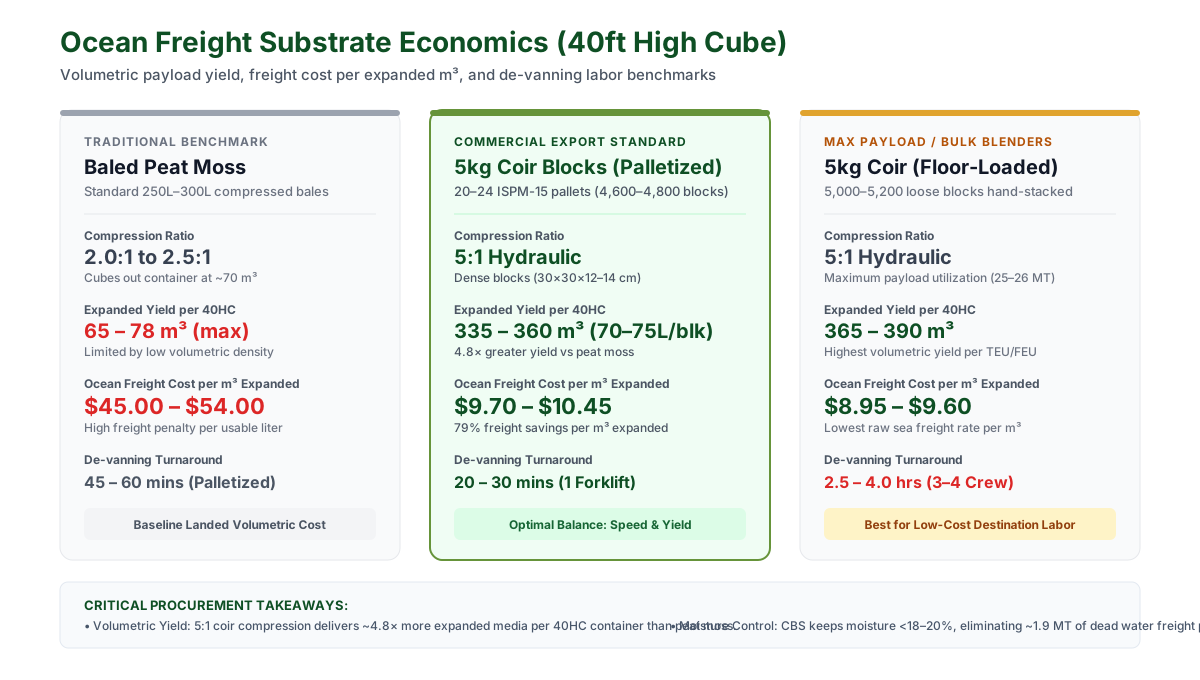
| Cargo & Physical Logistics Metric | Baled Peat Moss (Standard Baltic/Canadian) | 5kg Cocopeat Blocks (Palletized 40HC) | 5kg Cocopeat Blocks (Floor-Loaded 40HC) |
|---|---|---|---|
| Mechanical Compression Ratio | 2.0:1 to 2.5:1 | 5.0:1 | 5.0:1 |
| Cargo Form Factor | 250L–300L compressed bales | 30 × 30 × 12–14 cm dense blocks | 30 × 30 × 12–14 cm dense blocks |
| Packaging & Containment | Polythene stretch wrap on pallets | 20–24 ISPM-15 pallets, strapped & wrapped | Bulk hand-stacked into container floor |
| Net Payload per 40HC Container | 14.0 to 16.5 Metric Tons | 23.0 to 24.0 Metric Tons (4,600–4,800 blks) | 25.0 to 26.0 Metric Tons (5,000–5,200 blks) |
| Dry Cargo Volume Utilized | ~70 m³ (container cubes out) | ~52–58 m³ cargo + pallet tare | ~68–72 m³ (near max container volume) |
| Expanded Substrate Yield per 40HC | 65 to 78 m³ (65,000–78,000 L) | 335 to 360 m³ (335,000–360,000 L) | 365 to 390 m³ (365,000–390,000 L) |
| Landed Ocean Freight per m³ Expanded Media\* | $45.00 – $54.00 / m³ | $9.70 – $10.45 / m³ | $8.95 – $9.60 / m³ |
| Freight Cost per Expanded Liter | $0.045 – $0.054 / L | $0.0097 – $0.0104 / L | $0.0089 – $0.0096 / L |
| Container De-vanning Time | 45 – 60 min (Palletized) | 20 – 30 min (Single forklift operator) | 2.5 – 4.0 hours (3–4 warehouse workers) |
\Modeled on a benchmark long-haul ocean freight rate of $3,500 USD per 40HC container.*
Economic Implications for Large Commercial Buyers
As demonstrated in the matrix above, shipping a 40HC container of 5:1 compressed 5kg low EC cocopeat blocks from our East Java plant yields between 335 and 360 cubic meters of finished growing substrate when palletized, and up to 390 cubic meters when floor-loaded.
Because baled peat moss cubes out at just 65 to 78 cubic meters of expanded yield per container, the ocean freight cost per expanded cubic meter of peat moss is 4.5 to 5.0 times higher than that of 5kg cocopeat blocks. For international buyers located outside peat-mining regions, high compression density turns an overseas agricultural byproduct into a vastly cheaper base substrate than continental peat moss.
Moisture Control Economics: Eliminating "Dead Water" Freight
A critical yet frequently overlooked parameter in bulk coir procurement is baseline moisture percentage at the point of compression and container loading.
Because container freight rates apply to the entire container box regardless of whether payload consists of dry organic fiber or water, every percentage point of moisture above the technical minimum adds unnecessary dead weight.
The Financial Cost of Excess Moisture
International export quality standards mandate that 5kg cocopeat blocks maintain an internal moisture content between 15% and 20%. This moisture level ensures sufficient cohesion during hydraulic pressing without triggering fungal sporulation during ocean transit.
Consider what happens when an undisciplined producer packs blocks at 28% moisture instead of 18%:
- In a 24.0 Metric Ton shipment (4,800 blocks), an 8% excess moisture level represents 1,920 kg (nearly 2 metric tons) of water.
- At a freight rate of $3,500 per 40HC container, the buyer is paying approximately $280 in pure freight penalty solely to transport East Asian rainwater across the ocean.
- In container weight-limited jurisdictions (such as North American interstate highway gross vehicle weight laws limiting gross payload to 19.9–20.4 MT without special heavy-axle permits), those 2 tons of excess water force the shipper to reduce the total number of blocks loaded, cutting the buyer's delivered volumetric yield by over 28,000 liters per container.
Controlling drying fields through rotary drum dryers or covered concrete drying floors guarantees that moisture remains tightly clamped at 16%–18%, protecting buyer margins from dead weight freight waste.
40ft High Cube Container Palletization Engineering
Commercial buyers must choose between two export loading configurations: Palletized or Floor-Loaded (Loose Packed). Choosing the correct strategy depends on local labor rates, pallet disposal regulations, and warehouse equipment.
Palletized Configuration (20 vs 24 Pallets)
In automated substrate facilities and European or North American distribution hubs, palletization is standard practice. Blocks are stacked on heat-treated wooden pallets adhering strictly to ISPM 15 quarantine standards to prevent biosecurity interceptions.
- Standard 20-Pallet Straight Layout:
- 20 industrial wooden pallets (1000 mm × 1200 mm footprint).
- Stacking configuration: 4 blocks per tier, 12 to 14 tiers high (220 to 240 blocks per pallet).
- Total blocks: 4,400 to 4,800 blocks per 40HC.
- Total payload: 22.0 to 24.0 Metric Tons.
- Packaging integrity: Pallet corners reinforced with rigid cardboard V-boards, automated multi-layer stretch film wrap (minimum 23-micron gauge), and two vertical plus two horizontal heavy-duty PET strapping bands.
- 24-Pallet Pinwheel Configuration:
- Utilizes standard Euro-pallet dimensions (800 mm × 1200 mm) arranged in a interlocking pinwheel pattern inside the container.
- Total blocks per pallet: 190 to 200 blocks.
- Total blocks: 4,560 to 4,800 blocks.
- Optimized for narrow European truck chassis and automated automated guided vehicle (AGV) racking systems.
Floor-Loaded Configuration (Bulk Hand-Stacked)
In floor-loaded shipments, blocks are loaded directly onto corrugated cardboard lining on the container floor, stacked tier-by-tier up to 85% of interior container height.
- Total blocks: 5,000 to 5,200 blocks.
- Total payload: 25.0 to 26.0 Metric Tons.
- Strategic utility: Maximizes payload to the absolute structural limit of the container and ocean carrier bill of lading limits.
The De-Vanning Tipping Point: Palletized vs Floor-Loaded
While floor loading delivers an additional 300 to 400 blocks (1.5 to 2.0 MT of extra dry material) per container, destination unloading costs can completely erase that freight saving.
- Palletized Unloading: A single certified forklift operator can de-van a 40HC container in 20 to 30 minutes, staging pallets directly into drive-in pallet racking. Total destination labor: ~0.5 man-hours ($20–$35 total labor cost in Western markets).
- Floor-Loaded Unloading: Requires a 3-to-4-person crew working inside the container for 2.5 to 4.0 hours to manually move 5,000 blocks onto pallets. Total destination labor: 8 to 12 man-hours ($300–$500 in direct labor plus forklift standby).
- Demurrage & Detention: In congested international ports where free container dwell times are limited to 2 to 3 days, slow manual de-vanning increases the risk of carrier detention penalties ($150 to $250 per container per day).
Decision Rule: For destinations in North America, Western Europe, and Australasia where warehouse wages exceed $25/hour, palletized loading yields a lower total landed cost despite the slightly lower block count. For operations in regions with abundant, flexible labor or operations with high-capacity bulk conveyor receiving lines, floor loading remains the optimal route to maximize raw metric tonnage.
Strategic Origin Advantage: East Java Tollway to Port of Tanjung Perak
Ocean freight efficiency begins on land. In bulk agricultural exports, long inland drayage routes over congested secondary roads introduce severe freight variance, container chassis shortages, and missed ocean vessel cut-offs.
Our export processing operations in Sidoarjo, East Java, operate with a direct geographic advantage:
- Highway Proximity: Located 35 kilometers south of Pelindo Terminal Petikemas Surabaya (TPS) at the Port of Tanjung Perak.
- Direct Tollway Linkage: Fast transit via the Surabaya-Porong and Surabaya-Gempol expressway corridors allows container trucks to reach terminal export staging gates in 60 to 90 minutes.
- Container Equipment Availability: Tanjung Perak serves as the primary maritime logistics gateway for eastern Indonesia, ensuring continuous container depot supply of food-grade and agricultural-grade 40HC dry containers even during global equipment pinches.
Sourcing High-Spec Cocopeat from Sidoarjo, Indonesia
PT Ridha Dua Keluarga manufactures and exports precision 5kg cocopeat blocks engineered specifically for high-efficiency international ocean logistics:
- Strict Moisture Control: Clamped at 16%–18% moisture to ensure maximum volumetric payload without water freight waste.
- High Expansion Yield: Laboratory-verified 14–15 liters expansion per kilogram (70–75 liters per block) through automated 5:1 hydraulic pressing.
- Custom Palletization: Standard 240-block strapped pallets (ISPM 15 heat-treated) or bulk floor loading backed by verified container weight certificates (VGM).
- Clean Salinity Parameters: Washed Low EC (<0.5 mS/cm) and unwashed High EC options available with complete Certificate of Analysis (CoA) and phytosanitary clearance.
To request a formal CIF or FOB container pricing breakdown for your destination discharge port, contact our commercial export desk:
- Email: [email protected]
- Web Inquiry: cocopeatblocksidoarjo.com/#lead-form
- Export Facility: Krembung, Sidoarjo, East Java, Indonesia
Related Keywords & Topics
Technical Citations & Referenced Standards
Standard testing methods, government regulations, and industry benchmarks cited in this document.
CBS Agronomy Notes
Sourcing 5kg Cocopeat Blocks for Commercial Agriculture?
Receive customized EC/pH lab certificates, container stuffing simulation (palletized or floor loaded), and FOB Tanjung Perak pricing.
Related Technical Notes
View all →
26 October 2026
Commercial Blueberry Substrate: Balancing Low EC Coir Pith and Husk Chips for Acidic, Multi-Year Container Crops
Technical guide to engineering multi-year blueberry media: optimizing air-filled porosity (AFP 25-35%), bridging coir pH to 4.5-5.5, and low-EC salt management.
19 October 2026
Europe's Coir Supply Map: What 2024 Trade Data Shows About Supplier Concentration in the Netherlands and Germany
UN Comtrade 2024 data on Dutch and German HS 530500 imports: India supplies over half the volume, Indonesia barely registers. What that means for coir buyers.